How Time Zone Shifts Reshape Participation Cycles in Worldwide Card Competition Circuits
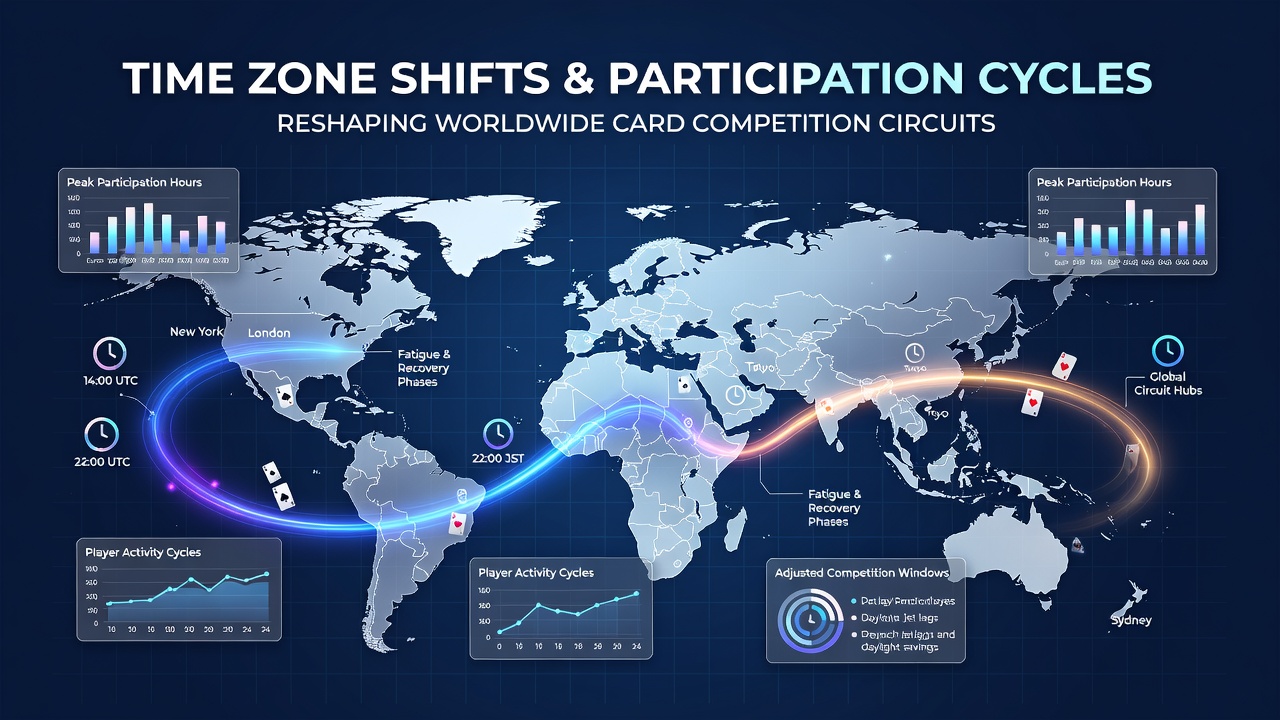 Card competition circuits that span multiple continents rely on fixed schedules often anchored to venues in Las Vegas or Macau yet these anchors create ripple effects across player pools when daylight saving adjustments and regional offsets shift registration windows by several hours. Observers note that European participants frequently adjust sleep patterns to align with American evening starts while Asian competitors encounter pre-dawn requirements during major series and these adjustments alter daily entry volumes in measurable ways. Data from tournament platforms indicate registration peaks migrate forward or backward depending on the offset between the host time zone and the player's local clock. In July 2026 several circuits schedule stops that coincide with European summer time changes and North American daylight saving transitions and these overlaps compress the available window for players in Australia and Japan. Figures reveal a drop in late-night entries from those regions while midday sessions attract higher numbers from South American time zones where afternoon hours align better with the broadcast schedule. Organizers respond by introducing staggered start times across satellites yet the core events remain locked to the primary venue clock.
Regional Registration Patterns Under Time Pressure
Players based in the UK and continental Europe encounter a consistent four-to-six-hour lag behind Las Vegas during summer months and this lag pushes optimal entry periods into late evening local time. Research indicates that participation from these zones declines when start times fall after midnight yet rebounds when satellites offer earlier feeder events that feed into the main draw. North American participants experience the opposite effect during the same window and their registration numbers rise because evening hours remain convenient.
Asian markets show sharper swings because the offset can exceed twelve hours and competitors in Singapore or Hong Kong must decide between abbreviated sleep or missing the opening levels entirely. Tournament software logs demonstrate that automated entry bots from these regions activate during local morning hours while human players cluster around lunch breaks or after-work windows when the timing permits. Circuit operators have introduced rolling registration extensions that allow late entries up to a set level and these extensions partially offset the geographic disadvantage.
Impact on Satellite and Feeder Event Volume
Satellite tournaments designed to feed players into flagship events follow the same time zone logic and their schedules determine whether emerging talent from distant regions can realistically qualify. When a main event begins at 3 p.m. Pacific time satellites in Europe often run at 11 p.m. or later and this timing reduces the pool of recreational players willing to commit to overnight sessions. Data shows that mid-week satellites suffer larger drops than weekend versions because work schedules compound the sleep disruption.

Operators have tested dual-time-zone listings on mobile apps so participants see both the venue clock and their local conversion and these listings correlate with modest increases in cross-regional entries. Industry reports compiled by gaming associations document similar patterns across multiple circuits and the pattern holds whether the events occur online or in physical venues. The adjustments remain incremental rather than revolutionary because core broadcast and dealer staffing requirements still tie back to the primary location.
Long-Term Adjustments by Organizers and Players
Over successive seasons circuits have experimented with rotating start times and occasional split-field formats that allow one portion of the field to begin earlier for certain regions. These experiments produce measurable shifts in the geographic distribution of the final tables and observers record more consistent representation from underrepresented time zones when the schedule rotates. Players themselves develop routines around jet-lag management and remote study sessions timed to the target event clock and these routines become part of the preparation cycle for professionals who travel frequently.
Academic studies on chronobiology applied to gaming environments suggest that sustained misalignment between circadian rhythms and tournament hours can influence decision speed yet circuit data focuses more on entry counts than cognitive metrics. Regulatory bodies in multiple jurisdictions track participation demographics and time zone effects appear in annual summaries alongside age and gender distributions. The cumulative record shows that circuits able to communicate start times in multiple local equivalents maintain steadier global attendance across calendar shifts.
Conclusion
Time zone offsets continue to dictate the rhythm of worldwide card competition circuits by moving registration peaks and altering which regions contribute the largest share of entrants during any given series. Organizers respond with software tools, staggered satellites, and occasional schedule rotations yet the fundamental anchor of venue time remains fixed. Participation cycles therefore reflect both geography and the willingness of players to adapt their daily routines around those fixed points and the patterns repeat with each daylight saving transition and seasonal circuit calendar.